Zuglängen-Auswertung/en: Unterschied zwischen den Versionen
Aus RailRoad&Co.-Wiki
Zur Navigation springenZur Suche springen
Uslex (Diskussion | Beiträge) Die Seite wurde neu angelegt: „*If there is a short train movement in the block: The detector does not trigger. *If there is a long train movement in the block: The detector triggers.“ |
Uslex (Diskussion | Beiträge) Die Seite wurde neu angelegt: „== Weblinks ==“ |
||
| Zeile 24: | Zeile 24: | ||
*If there is a long train movement in the block: The detector triggers. | *If there is a long train movement in the block: The detector triggers. | ||
== Weblinks == | == Weblinks == | ||
<div lang="de" dir="ltr" class="mw-content-ltr"> | <div lang="de" dir="ltr" class="mw-content-ltr"> | ||
Version vom 21. Dezember 2025, 18:20 Uhr
| Verwendung |

|
Evaluate train length via train description
Train description
The Train description function in TrainController from version V8 onwards allows, for example, the evaluation of train lengths.
To query trains longer than 200 cm, I created a signalman and assigned him a newly defined train length description.
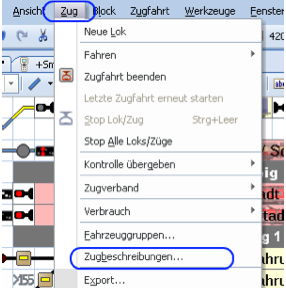
- Fig: Description of train lengths

Download instructions
The description shown Zuglaenge_auswerten.pdf checks all trains consisting of locomotives and carriages without any limit on the number of carriages.
- If there is a short train movement in the block: The detector does not trigger.
- If there is a long train movement in the block: The detector triggers.
Weblinks
- Anleitung: Zuglaenge_auswerten.pdf
- TC-wiki: Zugbeschreibungen und ihre Filterwirkungen
- -- Horst Lange 01. Juni 2013 (CET)
- bearbeitet: Uslex 13:25, 15. Aug. 2022 (CEST), Uslex (Diskussion) 16:17, 21. Dez. 2025 (UTC)