Signale grau und weiss im Fahrdienstleiter/en: Unterschied zwischen den Versionen
Aus RailRoad&Co.-Wiki
Zur Navigation springenZur Suche springen
Uslex (Diskussion | Beiträge) Die Seite wurde neu angelegt: „White signal backgrounds indicate whether a route exists for the train from its starting point to its destination. If a block or a set of points is removed from the route at any point along the way, the signal backgrounds turn gray.“ |
Uslex (Diskussion | Beiträge) Die Seite wurde neu angelegt: „== Weblinks ==“ |
||
| Zeile 31: | Zeile 31: | ||
White signal backgrounds indicate whether a route exists for the train from its starting point to its destination. If a block or a set of points is removed from the route at any point along the way, the signal backgrounds turn gray. | White signal backgrounds indicate whether a route exists for the train from its starting point to its destination. If a block or a set of points is removed from the route at any point along the way, the signal backgrounds turn gray. | ||
== Weblinks == | == Weblinks == | ||
<div lang="de" dir="ltr" class="mw-content-ltr"> | <div lang="de" dir="ltr" class="mw-content-ltr"> | ||
Version vom 1. Januar 2026, 19:00 Uhr
| Verwendung |

|
Grey and white signal images
Display of signal aspects in the train dispatcher
In the train dispatcher's view (not in the signal box), the signal backgrounds are grey in some blocks, and white in others.
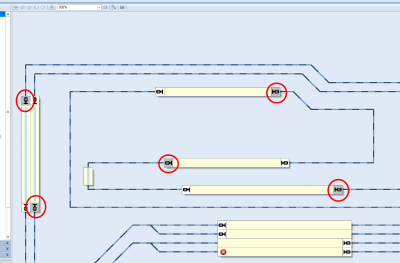
- Fig.: Grey signals in the train dispatcher'

When are the backgrounds grey and when are they white?
Direction of train journey
Uli Wassmann replies in the forum:
This indicates the direction of travel. The train always traverses the blocks from gray towards white.
Route from start to finish
Michael Mertner adds:
White signal backgrounds indicate whether a route exists for the train from its starting point to its destination. If a block or a set of points is removed from the route at any point along the way, the signal backgrounds turn gray.
Weblinks
- Quelle: Forum
- -- Uslex 19:49, 17. Dez. 2024 (CET)