+4D Soundanleitung/en: Unterschied zwischen den Versionen
Uslex (Diskussion | Beiträge) Die Seite wurde neu angelegt: „Why +4DSound? It allows you to create a '''spatial sound''' for your model railway, consisting of stationary sounds and sounds following the train.“ |
Uslex (Diskussion | Beiträge) Die Seite wurde neu angelegt: „''Fig: 4DSoundExample''“ |
||
| Zeile 17: | Zeile 17: | ||
Why +4DSound? It allows you to create a '''spatial sound''' for your model railway, consisting of stationary sounds and sounds following the train. | Why +4DSound? It allows you to create a '''spatial sound''' for your model railway, consisting of stationary sounds and sounds following the train. | ||
Only the combination of a background noise that matches the system | |||
*'''background noise''' together with the | |||
*''' | *'''locomotive noises''' and possibly | ||
*''' | *'''stationary noises''' creates a realistic sound image. | ||
*''' | |||
Locomotive sounds alone often seem too isolated. Ultimately, with +4DSound, a fourth dimension is added to the layout, and the beautiful result justifies the effort. | |||
:[[Datei:4DSoundBeispiel.png|400px]] | :[[Datei:4DSoundBeispiel.png|400px]] | ||
: | :''Fig: 4DSoundExample'' | ||
'' | |||
<div lang="de" dir="ltr" class="mw-content-ltr"> | <div lang="de" dir="ltr" class="mw-content-ltr"> | ||
Version vom 27. Juli 2026, 13:37 Uhr
| Verwendung |

|
+4D sound guide
The Problem
According to forum posts, the +4DSound program is languishing in obscurity, even though many users are surely interested. I suspect that for many model railroaders, getting started with this program is very time-consuming, and most give up after a few hours due to a lack of success. After all, apart from a minimal example, there isn't a single fully prepared locomotive with the corresponding sound files.
What can +4DSound do
Why +4DSound? It allows you to create a spatial sound for your model railway, consisting of stationary sounds and sounds following the train.
Only the combination of a background noise that matches the system
- background noise together with the
- locomotive noises and possibly
- stationary noises creates a realistic sound image.
Locomotive sounds alone often seem too isolated. Ultimately, with +4DSound, a fourth dimension is added to the layout, and the beautiful result justifies the effort.
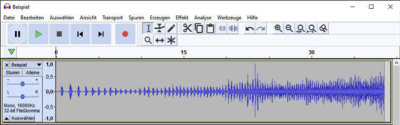
- Fig: 4DSoundExample

In diesem Beitrag hat uns Kollege Marek Spalinger die sehr umfangreiche Anleitung 4DSound_Anleitung_V3.pdf zur Verfügung gestellt.
Klangbeispiele
Zusätzlich zur PDF-Beschreibung gibt es auch noch 2 Klangbeispiele von Dampfloks Klang_Beispiele.zip, einmal ohne und einmal mit Naturgeräuschen. Damit sollte der Unterschied deutlicher werden, wenn der Loksound nicht alleine abgespielt wird sondern zusammen mit dezenten Naturgeräuschen. In den 2 Minuten werden Wetterwechsel während eines Tagesblaufs gespielt. Vielleicht erkennt ihr, was man alles hören kann.
Neue Version
Marek Spalinger hat die Anleitung 2022 in einigen Punkten überarbeitet. Dies betrifft vor allem die Darstellung des Gleisbilds im Stellwerk in Relation zu den Lautsprechern. Und dann gibt es noch ein paar Präzisierungen zu x.1 Soundsystemen und dem Thema Subwoofer.
- neue Version: 4DSound_Anleitung_V3.pdf
Und nun viel Spass mit +4DSound.
Weblinks
- Quelle: Forum
- Anleitung_V2: 4DSound_Anleitung_V2.pdf (Version von 2020)
- Anleitung_V3: 4DSound_Anleitung_V3.pdf (Version von 2022)
- Beispiele: Klang_Beispiele.zip
- TC-wiki: Geräuschdateien für die Verwendung mit dem Trainanimator vorbereiten
- TC-wiki: Lautsprecheranordnung und Soundeinstellung
- --Wohlmannstetter (Diskussion) 18:51, 24. Mai 2020 (CEST)
- bearbeitet: Uslex (Diskussion) 10:28, 29. Mai 2022 (CEST), Uslex (Diskussion) 07:00, 8. Dez. 2025 (UTC)