Anlagen NotAus/en: Unterschied zwischen den Versionen
Uslex (Diskussion | Beiträge) Die Seite wurde neu angelegt: „It should also be possible to specifically terminate individual train journeys so that they cannot start again.“ |
Uslex (Diskussion | Beiträge) Die Seite wurde neu angelegt: „=== Download document ===“ |
||
| Zeile 52: | Zeile 52: | ||
It should also be possible to specifically terminate individual train journeys so that they cannot start again. | It should also be possible to specifically terminate individual train journeys so that they cannot start again. | ||
< | <span id="Dokument_herunterladen"></span> | ||
=== | === Download document === | ||
<div lang="de" dir="ltr" class="mw-content-ltr"> | <div lang="de" dir="ltr" class="mw-content-ltr"> | ||
Version vom 17. Januar 2025, 10:43 Uhr
| Verwendung |

|
Emergency stop
Operational disruptions
The question that keeps cropping up is how best to react to faults that occur during operation of a model railway system, such as short circuits in the track or impending collisions, wrong turns, etc.
In both the TC Forum (German and English parts) specific situations are described and solutions discussed.
This was also the case at the TC Stammtisch in Munich.
Unfortunately, the TrainController variants Bronze and Silver do not offer the same functions as operations as the GOLD variant.
Users of the Bronze or Silver version may be able to perform the action in the form of "a quick finger" manually via the TC menu bar(s).
Incident scenarios
In diesem Dokument wird der Versuch unternommen ein Lösungskonzept für die verschiedenen Störfall - Szenarien anzubieten.
This document attempts to offer a solution concept for the various incident scenarios.
The methods and procedures presented here do not claim to be "error-free" and are certainly "capable of improvement".
The solution concept must be "ported" to the respective user's needs.
How it works
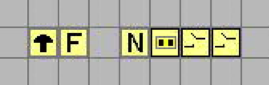
- Fig: Emergency stop system

Object functions (from left to right):
- STOP / Emergency Stop - switch: causes all trains to stop and blocks all (new) train journeys as well as those already started using block locks
- RELEASE - button: removes the train journey and block locks, sets the TC system to stop; Preparation for general release using the START button in the top TC menu
- Emergency stop sensor activation (switch): enables the suppression of the (occupancy) detector information
- Summary determination of a fault (trackman): switches on the "STOP / emergency stop switch" when a fault is detected by a detector
- Detector (e.g. track or switch): reports the re-connection of the track voltage after a fault * or the "statement" that a fault has occurred
- Detector (e.g. emergency stop button on the system): reports a fault triggered by the user
What is needed?
A function that continues to stop the train journeys, but allows individual objects on the system to be operated specifically and individually.
It should also be possible to specifically terminate individual train journeys so that they cannot start again.
Download document
Das Dokument kann als PDF unter dem Titel "TC-NotAus-Was_tun.pdf" aufgerufen werden.
Keine Änderungen im eingefrorenen Modus
Solange TrainController im eingefrorenen Modus ist, ist es streng verboten, am Zustand der Anlage etwas zu verändern. Eingefroren heisst eingefroren. Das gilt für das gesamte System.

Abb: Eingefrorener Modus
Eingefrorener Modus
Grundsätzlich und aus Sicherheitsgründen darf kein Status eines Objekts geändert werden, während die Sitzung eingefroren oder gestoppt ist.
Das bedeutet: Im eingefrorenen oder gestoppten Zustand können
- keine Fahrpläne gestartet,
- keine Blöcke reserviert,
- keine Fahrstraßen aktiviert,
- keine Weichen geschaltet,
- keine Druckknöpfe gedrückt,
- keine Makros oder Operationen ausgeführt werden usw.
Dies bedeutet insbesondere auch, dass die Systemoperation zum Starten der Anlage nicht ausgeführt werden kann, während die Anlage eingefroren ist.
Dies ist ein Grundprinzip und kann nicht geändert werden.
Wenn man im eingefrorenen Zustand etwas an der Anlage verändern will, muss TrainController zwingend in den Nothalt ("rote Hand") geschaltet werden.
TrainController geht üblicherweise in den eingefrorenen Zustand, wenn die Zentrale abgeschaltet wird oder einen Kurzschluss meldet.
Neustart nach Nothalt
In diesem Beitrag hat Herr Freiwald den richtigen Ablauf beschrieben.
Wenn TrainController in den Nothalt geschaltet wurde, so gibt es keine laufenden Zugfahrten mehr. TrainController hat damit auch keine Kontrolle über fahrende (oder in Bewegung gesetzte) Züge mehr. Die Zentrale ist (wenn möglich) so einzustellen, dass bei Wiedereinschalten der Zentrale die zuvor laufenden Züge nicht automatisch durch die Zentrale in Gang gesetzt werden. Aus diesem Zustand heraus können dann per Menübefehl alle zuvor aktiven Zugfahrten wieder neu (allerdings mit den aktuellen bzw. aktualisierten Zugpositionen) gestartet werden.
Weblinks
- Nothalt: Forum
- Anleitung: TC-NotAus-Was_tun.pdf"
- eingefrorener Modus: Forum
- TC-wiki: Nothalt bei Störung
- -- Jens Mohr 19:03, 16. Mai 2014 († 2023)
- bearbeitet: Wohlmannstetter (Diskussion) 14:59, 15. Apr. 2021 (CEST), Uslex (Diskussion) 11:30, 18. Jul. 2022 (CEST), Uslex (Diskussion) 19:19, 16. Jul. 2024 (CEST), DeepPurple 16:21, 16. Jan. 2025 (CEST)